
Port Personalities In Focus is proud to introduce you to Stefano Marello. Port Personalities In Focus, has become vital in our mission to introduce you to members of the Port, and Portuguese wine trade. In Focus is included in every newsletter, intent on promoting people who are not typically in the media’s spotlight. In Focus brings you candid comments, personal perspectives, and an understanding of the people inside Portugal’s wine trade: from marketing professionals, master blenders, owners, importers, winemakers, and managing directors. You will meet individuals who work at small family-owned firms to the largest wine companies in Portugal. We hope you’ll enjoy reading about the people who grace these pages.
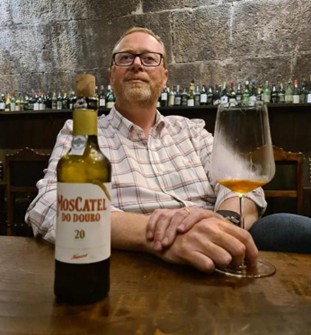
1. Please share some information about your life and how you wound up working in the Port trade, and at what age?
I was born in 1976 in Barcelos, at the time a small city some 60 kilometres north of Porto, from an Italian father and English mother. I moved to the greater Porto area in 1982, where I’ve lived all my life, except for a small 3-and-a-half year stint in Washington State in the US (working for Sogevinus, now Kopke Group). My family had nothing to do with Port, or any other wine for that matter. That would enter my life at a later stage, when in 1994 I started working at the Taylor’s lodge as a Tourist Guide during the summer months while university was off.
To be honest, at the beginning, my interest was in making some pocket money for gas and a few beers (!) so I wouldn’t have to ask my parents all the time, and it came as an easy choice, seeing as I spoke 5 languages and was a quick study. But then, like I believe happens to anyone that gets involved with Port Wine, I started to fall in love with it and wanted to learn more and more about it. This went on for about 4 years, and then just before I finished my studies, life took me in another direction. At the end of 1999 I had a chance to get back into the Port and wine world when I applied for a job at Real Companhia Velha (Royal Oporto).
Unfortunately, the position I took for 6 months wasn’t a great fit for me, and in one of those happy coincidences I ran into Alistair Robertson, at the time the Chairman of Taylor’s, who still remembered me and was surprised I wasn’t working for him. He immediately arranged for me to be hired, in charge of sales for a small but characterful brand called Romariz, under the supervision of another of the industry’s giants at the time, Mr. Albino Jorge da Silva e Sousa (by the way, that was around the time I first met Roy Hersh!).
Fast forward 8 years and a very happy marriage (now with two great kids, aged 21 and 13) when I accepted a change in position within the same group to move to the recently established local distributor, Heritage Wines. But by then the “export bug” was buried deep inside and in 2012, due to the impossibility of resuming my role at Romariz, I moved to Sogevinus, under the wing of then CEO, Gonzalo Pedrosa, as a Market Manager in charge of the UK, US and a few other markets. I was finally back! And then came an irrefusable proposition from Sogevinus, to run the recently acquired distributor Wineworth LLC in Bellevue, Washington for 3 years, and then prepare the merge with the company’s other US-based company, Wine in Motion (NJ), before returning home.
It was the first time I was in charge of a whole company, and I must tell you that I was scared as hell, of this challenge! In the end I was very successful in this endeavour, also due to the priceless support I had from one of Wineworth’s previous owners, Peter Pottschulte, so I returned to Portugal in the Summer of 2017 with the feeling of a job well done. I then resumed my role as a Market Manager for mainly the Scandinavian markets for several more years.
And then Niepoort happened, and nothing has been the same since then. Applying through a head-hunting company for an opening that had just been created, I went through all the interview and recruiting process with Jose Teles and finally, the man himself, Dirk Niepoort. The rest, as they say, is history and here I am today, as Niepoort’s Export Sales Director, working hard every day to promote not only Niepoort and Port Wine, but Portuguese wines in general, as the next big thing I believe they can be.
2. What is your favorite style or category of Port to drink at home, and can you mention some of the most memorable Ports you have ever consumed, and why?
That is a question anyone working in the trade is asked frequently, and it’s always a tough answer to give. I believe the best wines in the world are the ones you drink at a very specific moment, surrounded by the right people in the right place, and that makes you feel good. And for that it doesn’t need to be any style in particular, it’s the whole experience that counts. Romanticisms apart, I very much enjoy old Vintage Port and old Tawnies, usually the older, the better. I love seeing the effects ageing brings to the wine, be it in bottle or in cask, or in Niepoort’s case, in both! I’m quite partial as well to a good Dry White Port, as I love me some Portonic!
I’ve been fortunate over the last 25 years to have tasted some amazing wines, but to number just a few memorable ones and in no particular order of preference, Fonseca Guimaraens’s Vintage Port 1976 (coincidentally my birth year ), Niepoort’s 1863 Tawny Port and 1987 Garrafeira Port, Constantino 1963 Vintage Port, Kopke’s 1952 Colheita Port, Taylor’s 1945 Vintage Port, and a very underrated Quinta do Noval 1958 Vintage Port.
3. Besides those mentioned above, who are some Port producers that you most enjoy drinking, and please reveal a few emerging Port firms which have impressed you?
Another tough one, there are so many out here… Ramos Pinto, Noval, Taylor’s, Fonseca, Graham’s and Dow’s for older Vintage Ports, Andresen for all their amazing Tawnies and aged Whites, Kopke Group across all their brands for the great Colheitas (Tawny and White) to name a few …
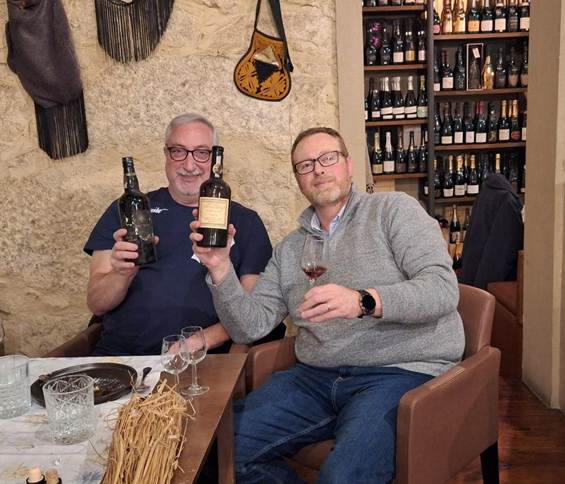
4. What brings you the most joy in what you do within the Port & Douro wine trade?
As I mentioned earlier, Export Sales have been my passion for a long time. It allows me to travel the world and discover not only new countries, but also to get to know different cultures and ways of thinking, which is a part I’m particularly interested in.
Cultural Anthropology is fascinating to me, how different people from different countries react to the same input, and the changes I must make to my approach in order to achieve the results I’m looking for. Also, to bring the discovery of something new, especially with regards to still wines, is extremely satisfying. A lot of consumers don’t have the faintest idea of what Douro still wines are all about, and the history behind them, they only know Port (and sometimes not even that). So, when you see in their eyes that look of satisfaction and surprise you know you’re doing it right. I call it jokingly “spreading the wine Gospel”. And I can humbly say I have converted quite a lot of people throughout the years!
5. Would you please share one piece of unique trivia or historical information about your current company that would be new to FTLOP readers?
Most FTLOP readers will know that Niepoort, among other innovations, created a brand-new category called Garrafeira, but they might not know the origin. It all started at the end of the 19th century when Eduardo Kerel Jakob Van Der Niepoort, the 2nd generation in charge of the family business, while travelling in Germany, came across a warehouse filled with these large bottles (typically used at the time in Pharmacies – Apothecaries for mixing and dispensing medicine). In true Niepoort style, already very marked even that early on in the company’s history, he bought and shipped to Portugal between 3.000 – 4.000 bottles, even without having a clear idea of what to use them for.
But that’s the vision that has characterized so many members of the family during the 183 years of the company’s existence! In the ensuing years several experiences took place, and many wines were bottled in these large-format bottles, which are called “Demijohns”.
Finally, with Port Wines from the 1931 harvest, the first thus-labelled Garrafeira Port was created. Today, Garrafeira is an officially recognized Port Category, but for many years its was like a “bastard child” of the trade, accepted, but not showing in any official literature, just having to generally follow the rules for ageing Colheita Ports, which never stopped Niepoort from continuing making it.
I like to call Garrafeira a hybrid between a Tawny aged a few short years in pipes and a light Ruby style, aged in large-format demijohns for many more years before finally being released, where it gains what Dirk calls the “bottle sickness” that is so typical of Niepoort’s bottle-aged Tawnies (and yes, some companies’ Tawny Ports can be aged in the bottle for many years!). To this day, Niepoort remains the sole company to produce Garrafeira Port, although rumour has it that since it was officially recognized and had specific rules attributed, a couple of companies are working on their first release as well, a welcome addition to the family.
6. Which individual has been your greatest mentor and how have they inspired you?
Most “bosses” I’ve worked with have taught me valuable lessons, but going back to the beginning, when it was all new to me, I must say that Taylor Fladgate’s Albino Jorge was the strongest professional influence I’ve had in my career.
Apart from recognizing early on my capabilities for this business and trusting me with the autonomy I needed to do my job, he instilled in me a work ethic with some principles that guide me to this day. He taught me that if you treat all people equally well, they will be good to you, regardless of how big or small a customer is, they are all important.
Your given word is the strongest contract you can possibly have, “a promise made is a promise fulfilled”. Always reply to any communication received, as quickly as possible, even if it is to say, “message received, I’ll come back to you with an answer as soon as possible”. And always be a good and generous host, that is the memory your customers will take back home after visiting you. Finally, you don’t need to show off, or be the star of the show, a low profile and keeping below the radar is often a good strategy.
7. What is the greatest challenge facing the Port trade today? What about the Douro wine trade?
It has been a much-discussed subject for many years now. It’s undeniable that the volume of Port sales has gone down and will probably continue to do so. The average age of Port drinkers is increasing (except for some markets). But I’m not as pessimistic as some colleagues from other companies are. I believe there is light at the end of the tunnel. The numbers are showing us, whether we like it or not, that there is a future, but different than what we have today.
The many years the Port Trade spent selling huge volumes of entry-level wines at almost cost price are now taking their toll. This has created a mass industry that currently is actually bigger than the market it serves, and the results are reflected in the drop in volumes sold. On the other hand, you see this big decrease in entry-level Ports, but other, so-called special categories, are faring much better, or at least maintaining their sales. I see a future where companies must focus on the quality of the products they are offering instead of their price. Quality has its price, just look at Champagne for example, which has managed to keep a much higher price than Port, even though it has much more favourable production conditions and costs.
At the same time, a “war” is being waged against wine in general. I don’t think anyone is advocating the consumption of large quantities of wine, but I personally feel there is an exaggerated attack with legislation, sometimes varying from country to country even within the EU, mandatory posting of caloric information on the labels or through a QR code on the bottle, recycling information that is so confusing in some countries that it is hard for a producer to keep track of. It looks like you are made to feel guilty for having a glass of wine. We mustn’t also forget the effects these actions will have on a lot of countries’ economies… MODERATION should, in my opinion, be the key word.
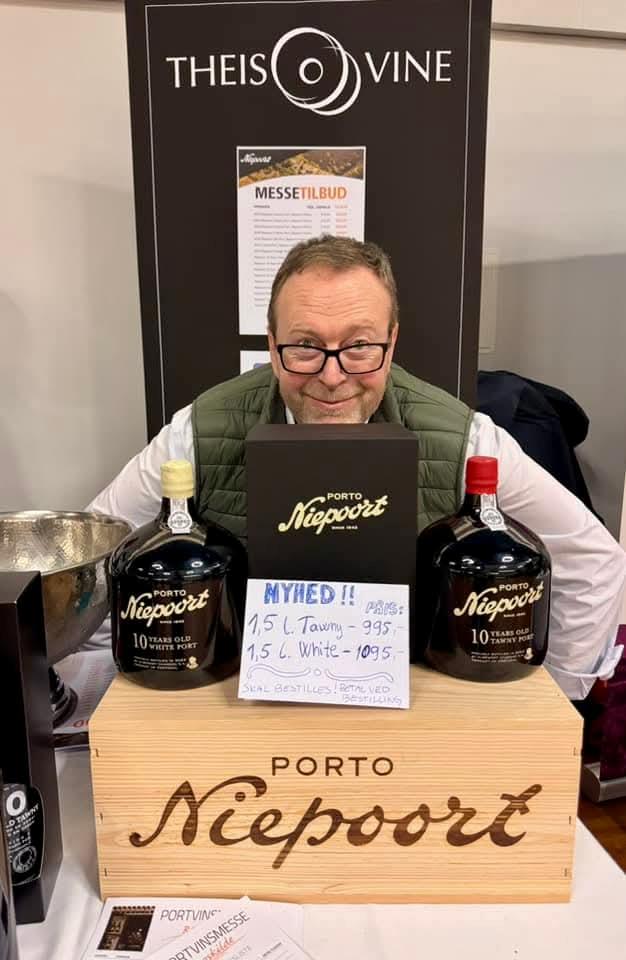
8. Can you share one new project or improvement that your company is currently involved with?
There is always so much happening at Niepoort that it is hard to put a finger on one single project. Probably one of the biggest is the construction of a new production complex in Vila Nova de Gaia, outside the historical World Heritage area which, as beautiful as it may be, poses a serious problem in terms of space and logistics. In this new complex we will have an increased production capacity, with better conditions, and more storage space. The reduction of our lead times and the facilitation of production processes are a couple of the main objectives here.
At the same time, we have been investing heavily in understanding the terroir of the different regions where we currently have our vineyards (Douro, Dão and Bairrada). All of our own vineyards are already certified Organic, but we are trying to go beyond that, with improvements in planting, pruning, treatment (we use many biodynamic practices already), all with the objective of reducing our impact on Nature while still delivering beautiful, elegant wines that are very much in demand the world over these days (in fact, a trend Dirk predicted and started in the Douro Valley, many years ago).
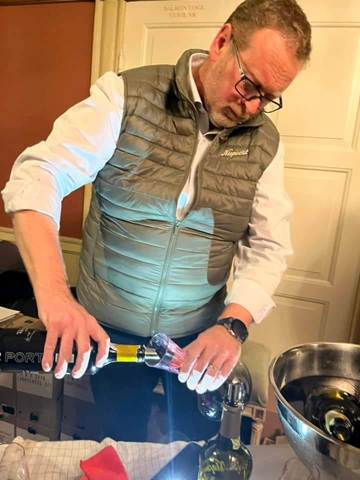
9. What can the industry do to improve the promotion and education of Port wine and grow market share in the ever-evolving global beverage marketplace?
I think we need to, above all, continue to focus on quality, uniqueness, and innovation, and not let ourselves fall into the old mantra “this is how it has always been done”. We need to attract new consumers, interested and educated in wine, that can grasp the value of what they have in their glass and the noble region where it comes from.
Lighter styles of Port, with less sugar and more elegant are the way forward. Today we are able to produce Ports in this style while at the same time keeping the quality and ageing potential, something that in the past was difficult to do. A couple of great examples of this are our latest Vintage Port releases (since 2017 especially) and our fun and cool “Trudy, the true Ruby”, which we launched in 2021 and is part of our Nat’Cool range.
10. What non-wine activities do you enjoy?
With all the travelling that this job involves, I find myself enjoying more and more the quiet times with friends and family, invariably around a bottle or two of something nice usually at ours or a friend’s house, more than going out.
My only “folly” or “sign of a mid-life crisis” was, at the age of 46, to get my motorcycle driver’s license for the first time and buy a motorcycle. This was something I had wanted to do since I was a kid, and I decided the time was right. I also still think that it is better (and cheaper) than going out and buying a red convertible!

Leave A Comment
You must be logged in to post a comment.